
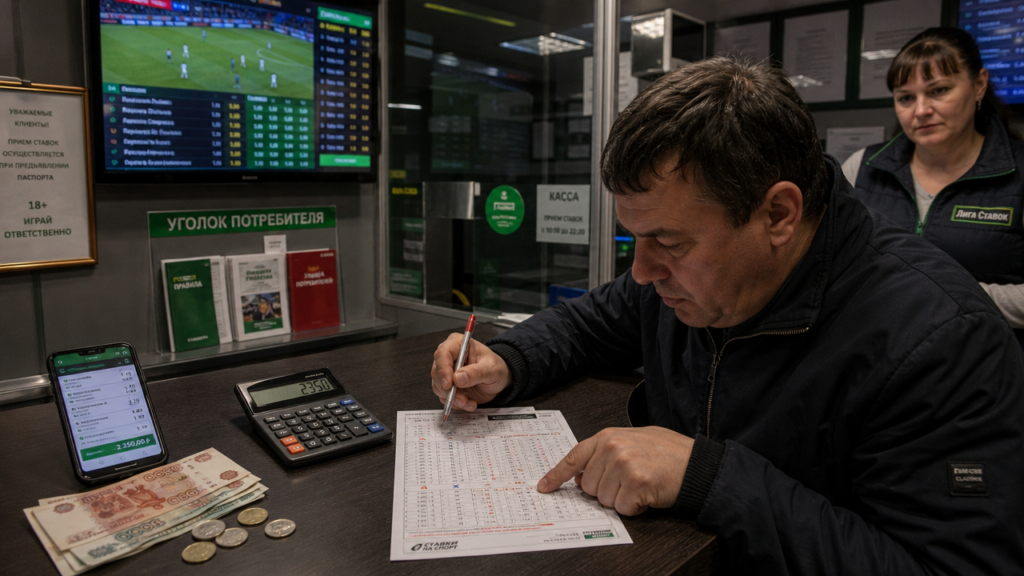
A system is a coupon that combines several smaller express bets. The notation “3 of 5” or “3/5” means each mini-express includes three events, and the full coupon contains five events. From those five selections, the bookmaker forms all possible three-event express combinations. In a 3/5 system, there are 10 such combinations. A $10 stake is split evenly across them, so each mini-express gets $1. You get paid when at least three selections win, even if the other two lose. That is the core difference from a standard express, where one wrong pick eliminates the entire bet.
Some betting platforms reverse the notation as “m/n”, where m is the number of events in each mini-express and n is the total number of selections. The system requires a minimum of three events. Duplicate outcomes from the same market and mutually exclusive picks, such as both teams winning the same match, cannot be included in one system.
How is a system bet calculated at a bookmaker’s office
Winnings are the sum of all winning mini-expresses. Each mini-express is calculated separately: the odds of its selections multiply together, and the result is multiplied by that combination’s share of the stake. Losing combinations return zero. The bookmaker does not use one average coefficient for the whole system.
A fixed stake option changes this structure. If you lock a selection as a fixed stake, it is added to every combination. A loss on that locked selection removes all combinations and returns zero for the entire system, regardless of other winning packages.
Example of a 3/5 settlement
Assume a $10 stake on a 3/5 system. The five selections have odds 1.8, 2.0, 2.2, 1.9, and 2.1. The 10 combinations each receive $1. If the first three selections win, only the combination 1.8 x 2.0 x 2.2 pays. Its coefficient is 7.92, so the payout is $7.92. That is below the $10 stake, which reflects the cost of covering many combinations.
If four selections win (1.8, 2.0, 2.2, and 1.9), there are four winning combinations. Their payouts are 1.8 x 2.0 x 2.2 = 7.92, 1.8 x 2.0 x 1.9 = 6.84, 1.8 x 2.2 x 1.9 = 7.52, and 2.0 x 2.2 x 1.9 = 8.36. The total payout is $30.64. If all five win, all 10 combinations pay. This structure tends to produce smaller maximum returns than an all-five express on the same $10 stake.
System size, margin, and bankroll rules
Bookmakers set structural limits. Some operators allow up to 16 selections in a system, others up to 20, and some up to 30. Larger systems multiply combinations quickly: a 2/6 system has 15 combinations, a 3/8 system has 56. More combinations mean more separate margin charges, because every mini-express contains the bookmaker’s overround. That is why 2/6 and larger structures often look safer but spread the stake across many low-payout outcomes.
Practical filters from betting analysts include avoiding odds below 1.5 and not risking more than 5 percent of the bankroll on a single system. Three common structures are 2/4 for favorite-heavy cards, 2/3 for high-odds value picks, and 3/5 for mixed reliability. These are not guarantees; they reduce the number of nearly dead combinations. A bookmaker will reject a coupon that includes duplicate outcomes or mutually exclusive picks from the same event.
Law on bets at bookmaker offices
Legal betting in Russia operates under Federal Law No. 244-FZ of 2006. Bookmakers must hold a license from the relevant tax authority. Government Decree No. 1221 of August 2020 updated the operating rules. Betting is separate from casinos, lotteries, and totalizators. The law allows bets only on official sports competitions organized by recognized sports federations. A system bet cannot be accepted on an event that falls outside that definition.
Physical requirements are strict. A bookmaker office must be in a permanent structure, never a temporary building. The law prohibits locations in residential zones, educational and medical facilities, transport hubs, government buildings, and religious sites. Each office needs a dedicated cashier area. Processing centres must record all bets and payouts. More than 200 licensed operators work in the country. This framework means a licensed operator can accept a 3/5 system at a betting counter, but a random kiosk in a railway station cannot.